Faith, Belief & Our Culture of Belonging
The Brief
How does a global firm help its people navigate faith, belief and difference; without telling them what to think?
Deloitte operates across 150+ countries — tens of thousands of employees, dozens of belief systems, a political environment growing more fractious by the month. Previous inclusion training had struggled to land. Either too abstract to feel personal, or too directive to invite genuine reflection. In a period of rising global tension and tightening DEI scrutiny, the cost of getting this wrong wasn’t theoretical. It was reputational and cultural.
The Solution
Stop centring the story on victims and villains. Show how everyone is affected
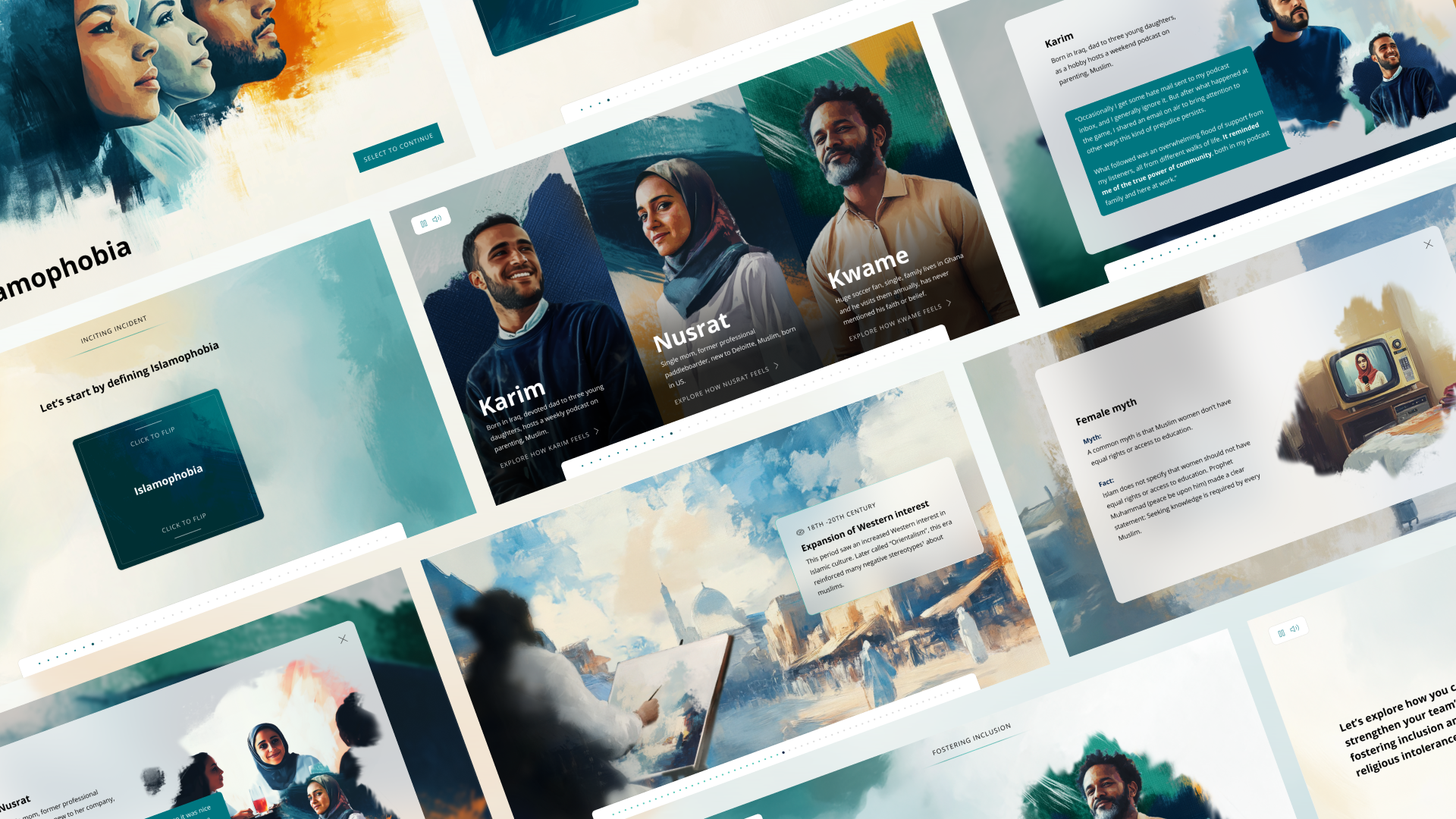
A three-module cinematic learning experience built on a single reframe: intolerance doesn’t just affect its targets — it affects everyone. Shared characters, a distinctive painterly visual language, and the metaphor of the ripple effect transformed a topic people habitually approach with defensiveness into one they approached with genuine curiosity.
There’s a story behind the story
This case study is under wraps. Enter the password to see the full work — or drop us a line and we’ll let you in.
or get in touch
Background
Global conflict, shifting language, and a firm that couldn’t afford to get either wrong
Deloitte’s scale makes it one of the world’s most culturally complex organisations. Employees across dozens of countries bring vastly different belief systems, political contexts, and lived experiences — many of them in active tension with one another.
At the time of this project, that complexity had intensified. Global conflict was reshaping attitudes. In the United States — Deloitte’s largest market — DEI was under political and legal scrutiny. Terms that had been standard were subject to risk review. Content required sign-off at every level. The margin for error was essentially zero.
Previous approaches to this kind of content had relied on clear moral positioning: subjects at the centre, consequences spelled out. The problem is that clear framing creates distance. Viewers assign roles and watch from a safe remove. Nothing changes.
Faith, Belief & Our Culture of Belonging — Experience Trailer
Our Approach
Reframe the problem. Then build something people would actually feel
We began by challenging the implicit framing. Rather than centring the experience on subjects of intolerance, we proposed a broader lens: how does intolerance affect everyone in an organisation? That single shift changed what the content needed to do — and who it was for.
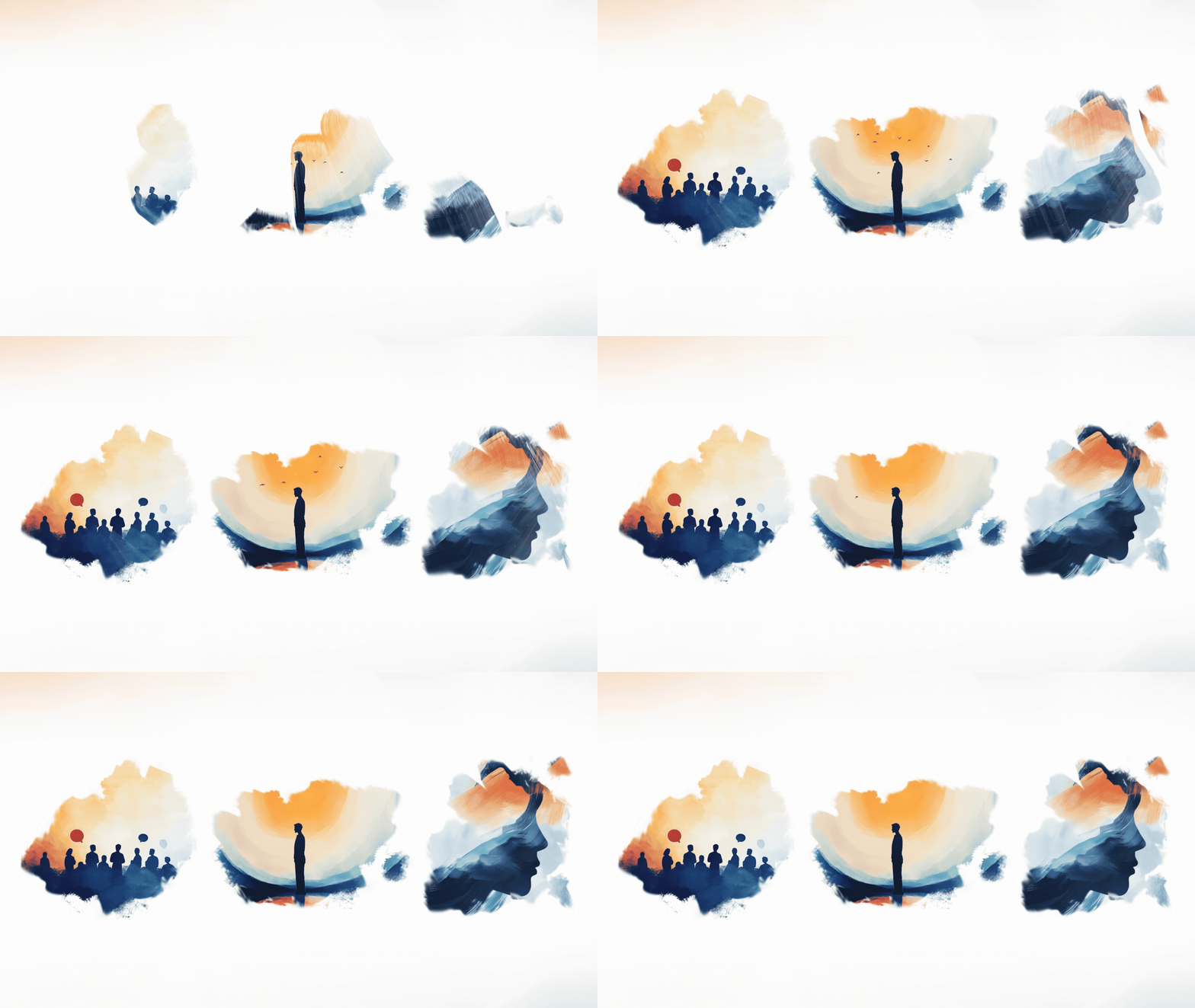
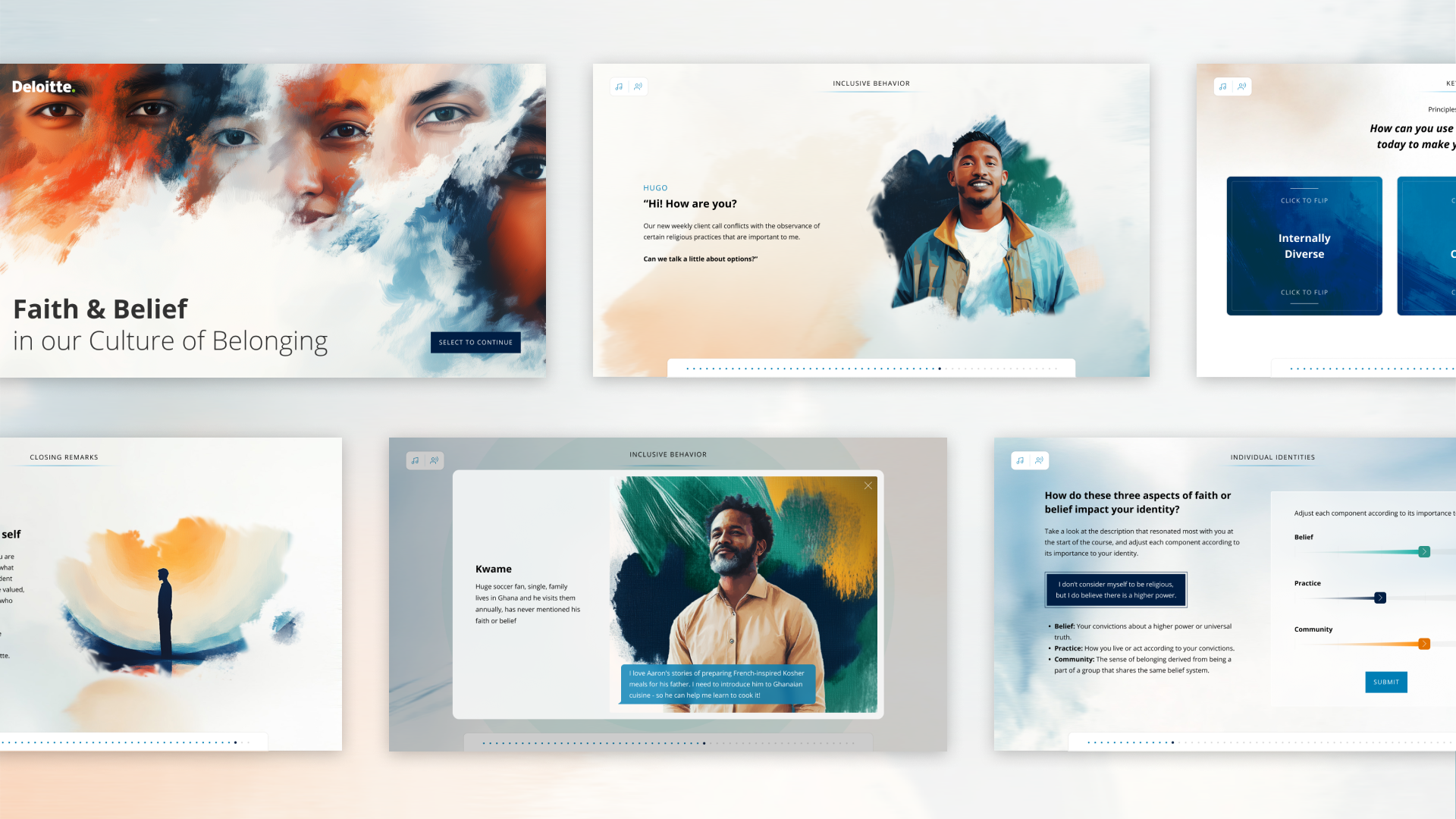
The ripple effect became the organising metaphor. Individual actions — a comment, an assumption, a silence — don’t end where they start. They spread. That insight gave the experience its narrative engine and its visual language: painterly, fluid, layered, with colours representing belief and identity blending rather than sitting in separate boxes.
We built a cast of recurring characters whose lives intersect across all three modules. By the third, they feel like colleagues, not case studies. Empathy accrues without being instructed.
As the political landscape shifted mid-production, we adapted tone and phrasing in real time — maintaining clarity without confrontation, and neutrality without blandness. Strategy and creativity moved together throughout.
Module Teasers
Key Project Assets
Foundational Module: Faith and Belief in Our Culture of Belonging
The series entry point — establishing context around belief, identity and respectful curiosity in the workplace, and introducing the characters and visual system that carry through all three modules.
Module Two: Exploring Antisemitism
A focused module addressing historical context, common myths and modern expressions of antisemitism through a human, non-partisan lens — grounded in the same narrative care and tonal consistency as the wider experience.
Module Three: Exploring Islamophobia
A parallel exploration using the same recurring characters and ripple metaphor, ensuring emotional continuity and cultural sensitivity across the full series.
Painterly Visual Language System
A fluid, motion-led visual identity representing identity as something lived and layered — elevating the experience well beyond standard e-learning aesthetics and making the metaphor visible.
Shared Character Framework
A diverse recurring cast whose intersecting lives carry learners across modules, building genuine familiarity and empathy through accumulated story rather than one-off illustration.
Impact
The foundational module earned strong qualitative endorsement from a client navigating real institutional risk — praised explicitly for its ability to handle a complex subject with clarity and humanity.
Project Insights
From compliance module to cultural mirror
The hardest thing in inclusion work isn’t the content. It’s the frame. When people feel positioned as either the problem or the solution, they disengage. The ripple effect reframe worked because it made the experience universal — not as a way to avoid difficult material, but as a way to make it land for everyone.
Three modules, built in some of the most constrained political conditions either party had navigated. A client who says the work handled a sensitive subject with clarity and humanity. When you make people feel the weight of something without telling them what to feel, the work does what no policy document ever could.
We didn’t set out to make people agree on anything. We set out to make them curious about perspectives they’d never considered. That’s a fundamentally different brief — and a fundamentally different result.
Paul Mallaghan, Director of Creative Strategy & Content — We Are Tilt